

Buoyancy Over Brute Force: The Missing Layer

The oldest flying technology in human history is also, I would argue, the one most capable of solving some of the hardest infrastructure problems of this century. And almost nobody is talking about it seriously.
We live in an era of intense fascination with extreme altitude. Rockets reach orbit. Drones swarm urban skies. Satellite constellations are assembling overhead at a pace that would have seemed implausible a decade ago. And yet the altitude band stretching from roughly 20 to 50 kilometres above the Earth's surface "the stratosphere", remains almost entirely unoccupied. Not because physics forbids it. Not because the engineering is impossible. But because, somewhere along the way, we collectively decided that the sky was either a transit corridor for aircraft or a staging ground for spacecraft, and nothing in between warranted serious attention.
That gap, sitting silently above the weather and below the orbital lanes, is one of the most consequential infrastructure voids on the planet. And lighter-than-air platforms, the technology we perfected two centuries ago and then largely set aside, are the most natural way to fill it.
The Infrastructure Gap Nobody Names
Think of the world's connectivity infrastructure as existing across three distinct layers. The first is the ground layer: towers, fibre cables, roads, power grids. It is the foundation of modern civilisation, but it is also expensive, slow to deploy, and thoroughly uneven in its reach. Hundreds of millions of people live beyond its practical margins, in mountainous terrain, in remote archipelagos, in the vast interior regions of continents where the economics of laying cable simply do not work. The infrastructure exists where capital has historically flowed, and that map has never corresponded neatly to where human beings actually live.
The second layer is low-Earth orbit. The enthusiasm around LEO satellite constellations is genuine and partly justified, they can reach places the ground layer cannot. But satellites orbit at altitudes of ~400 to ~35,000 kilometres. Even in the best-case geometry, you are communicating with a platform that is hundreds of kilometres away, moving rapidly across your sky, and incapable of providing the kind of sustained, dedicated coverage that true persistent infrastructure demands. The physics of distance impose their own costs, in signal strength, in latency, in the economics of maintaining a constellation large enough to ensure continuous availability over a given region. These are not insurmountable problems, but they are real ones.
Between these two layers sits the middle layer: the stratosphere. A single stratospheric platform operating at 20 kilometres altitude has an unobstructed line-of-sight to a surface footprint stretching hundreds of kilometres in every direction. It sits above the jet stream, above commercial air traffic, above cloud cover and weather systems. It is close enough to the Earth that signal strengths are manageable with modest hardware; far enough that a single platform can serve the connectivity needs of a mid-sized country. And it is, at present, almost entirely unused.
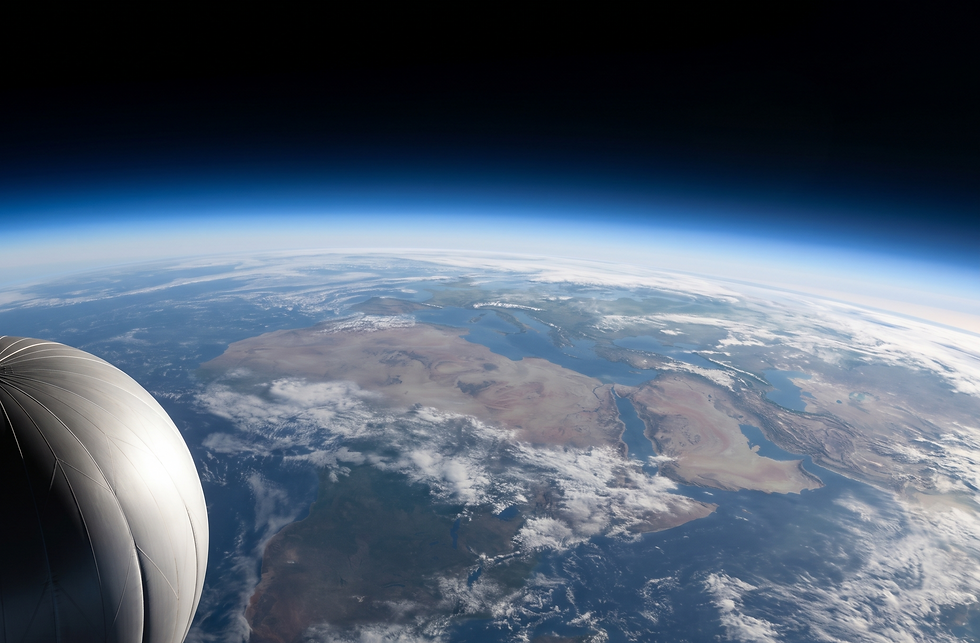
The implications of this gap are not abstract. More than three billion people lack access to reliable internet connectivity. When a cyclone, earthquake, or flood strikes, the first infrastructure to fail is usually terrestrial communications, and the last to be restored. Climate scientists rely on sparse surface measurements and infrequent satellite passes to understand atmospheric dynamics over vast regions. The absence of a persistent aerial layer does not show up as a single catastrophic failure; it shows up as a chronic, diffuse inadequacy, a world that is less informed, less connected, and less resilient than it could be.
This is not a technical problem. The physics of the stratosphere have been understood since the early twentieth century. It is a failure of strategic imagination, a collective decision, never quite made consciously, to skip the middle layer and build around it instead.
A Brief and Honest History
The first human beings to fly did not do so in an aircraft. They did so in a balloon, a linen envelope filled with hot air, constructed by two brothers in a French village, ascending on a November morning in 1783. From that moment until the first decade of the twentieth century, lighter-than-air flight was not a curiosity; it was the entire field of aviation. Military observation balloons changed the nature of siege warfare. Gas-filled airships crossed the Atlantic and operated scheduled passenger services. Stratospheric vehicles, ascending in sealed gondolas, pushed the boundaries of what was known about the upper atmosphere and cosmic radiation.
Then fixed-wing aviation arrived, and the cultural gravity of flight shifted permanently toward speed. The aeroplane was faster, more manoeuvrable, and crucially it felt more like the future. Lighter-than-air technology did not become obsolete; it became unfashionable. The Hindenburg disaster in 1937 provided the narrative punctuation that popular history needed to close the chapter. Airships were dangerous. Balloons were for children and fairgrounds. The field was abandoned not through any rigorous technical assessment, but through a combination of tragedy, aesthetics, and the intoxicating pace of heavier-than-air development.
The question worth sitting with, decades later, is whether that was the right call. For passenger transport and cargo between fixed points, fixed-wing aircraft and eventually jet engines were clearly superior. But persistence? Endurance? The ability to remain stationary over a target area for days or months at a cost that a government or a utility could actually afford? Those were never the things aviation was optimising for. We set aside a technology that was genuinely excellent at a specific set of tasks, because those tasks did not appear important at the time.
They are important now.
Physics Actually Offers
The case for stratospheric LTA platforms rests on a set of physical properties that do not bend to marketing or optimism, they are simply what the numbers say.
The most important property is persistence. A properly designed super-pressure stratospheric vehicle can remain aloft for weeks to months without requiring refuelling, landing, or active propulsion to maintain altitude. A satellite in low-Earth orbit passes over a given point for minutes at a time; to achieve continuous coverage, you need many of them, distributed precisely in an expensive constellation. A conventional aircraft can stay airborne for hours before it must return to a runway. A stratospheric platform operating on buoyancy, with altitude maintained by the pressure differential between its interior gas and the ambient atmosphere, can simply stay. Over a disaster zone, a border region, a stretch of ocean, or a remote community, that persistence is not a nice-to-have. It is a fundamental change in what the infrastructure can do.
The second property is coverage geometry. At ~20 kilometres altitude, the line-of-sight horizon extends to approximately ~500 kilometres. A single stratospheric platform positioned above central India, for instance, has clear geometric access to an area comparable to the entirety of several Indian states combined. Providing the same continuous coverage using terrestrial towers would require thousands of installations, years of civil works, and capital expenditure that is simply unavailable in the regions that need connectivity most. Using LEO satellites would require a substantial constellation and the ground hardware to manage handoffs between rapidly moving nodes. The stratospheric platform sits still, or nearly so, and the geometry does the work.

The third property is the nature of the stratospheric environment itself. This requires some care to explain, because the stratosphere is often described as harsh, which it is in certain specific ways, while being overlooked for the ways in which it is actually quite stable. Above approximately 12 kilometres, weather systems as we experience them at the surface do not occur. There is no precipitation, no convective turbulence of the kind that challenges aircraft, and no lightning at operational altitudes. The stratospheric winds are layered and, in certain latitude bands, remarkably predictable, a property that experienced balloon operators have used for decades to navigate vehicles thousands of kilometres with surprising precision, simply by ascending or descending between wind layers. The challenges are real: temperatures drop to −60°C or below, air density is roughly a tenth of sea-level density, and the ultraviolet and radiation environment demands materials that can withstand continuous exposure. But these are engineering constraints, not physical barriers. They define the design problem; they do not preclude it.
The fourth property is energy efficiency. A buoyant vehicle does not fight gravity, it is in equilibrium with it. The energy required to keep a lighter-than-air platform aloft is not propulsive thrust but rather the lifting gas contained in its envelope. Compare this with a solar-powered fixed-wing aircraft attempting to maintain station at stratospheric altitude: it must generate enough lift from wings working in air that is ten times less dense than at sea level, run propulsion continuously to counteract wind drift, and store enough energy in batteries to survive the night. The mass and power budgets involved are punishing. Buoyancy, by contrast, is essentially free. The platform floats. The energy budget can then focus almost entirely on payload operation, communications, and the modest station-keeping that atmospheric navigation requires.
Finally, there is deployability. A stratospheric vehicle can be launched from an open field. There is no runway, no orbital insertion burn, no complex ground infrastructure required. A trained team with the right equipment can have a platform airborne within hours of arrival at a site. In a humanitarian crisis, in a conflict zone, in any situation where permanent infrastructure has been destroyed or was never built, this matters enormously. The response time and logistical footprint are simply different in kind from any alternative.
Where the Hard Work Lives
Intellectual honesty requires that this case not be made without its counterweight. Stratospheric operations are technically demanding in ways that should not be minimised.
The envelope materials problem is genuinely difficult. A super-pressure vehicle must maintain a fixed volume against the diurnal pressure cycling driven by solar heating and nocturnal cooling, pressure differentials that repeat every day, for months, across a material that must also survive temperatures approaching −80°C. Conventional polyethylene films become brittle at those temperatures. Multilayer barrier films incorporating gas-impermeable layers introduce delamination risks at low temperatures. The seam engineering between envelope panels must accommodate stress concentrations that, if poorly designed, become failure initiation sites. None of this is unsolvable, but it demands rigorous materials science and testing programmes rather than the assumption that off-the-shelf film will suffice.
Station-keeping, the ability to remain over a target region rather than drifting with the wind, requires sophisticated atmospheric modelling and, for active platforms, some form of propulsion. The stratospheric wind field varies with altitude, season, and latitude in ways that take years of data and modelling to predict reliably. Regulatory frameworks for operating in this airspace are nascent in most countries, and the processes for obtaining flight clearances are neither standardised nor straightforward. The supply chain for specialised envelope materials, lifting gas infrastructure, and flight-qualified avionics at this altitude class barely exists outside of a handful of scientific programmes and a small number of commercial operators.
These are not reasons to dismiss the technology. They are the precise reasons why serious engineering investment in this field is overdue. Every infrastructure technology that humanity has eventually built, electrical grids, undersea cables, cellular networks, passed through a phase where the challenges were described as prohibitive before the combination of need and engineering attention made them tractable. The stratospheric layer is at that phase now.
An Infrastructure Layer for the Next Century
Every infrastructure layer that humanity has built has done more than solve the immediate problem it was designed for, it has unlocked capabilities that were previously unimaginable. Road networks did not just move goods faster; they restructured where people chose to live and how economies organised themselves. Electrical grids did not just replace candles; they made the factory system, the hospital, and the modern city possible. The internet did not just accelerate communication; it created an entirely new substrate for commerce, science, governance, and culture to occur on.
The stratospheric layer will do the same. Not as a replacement for ground infrastructure or for satellite constellations, but as a complement that makes the entire system more capable, more resilient, and more equitable. Persistent aerial coverage means that the connectivity map of the Earth can finally detach from the investment map, that a remote community in a mountainous region or a small island nation is not excluded from reliable communication because the capital to build towers was never available. It means that when a disaster strikes and terrestrial infrastructure collapses, communication can be restored within hours rather than weeks, not by waiting for fibre to be relaid but by deploying platforms from a staging area that can be anywhere. It means that the atmosphere, the thin, dynamic, critical envelope that regulates the climate, can be monitored continuously and in fine spatial detail, rather than being inferred from sparse point measurements.
The question is not whether these capabilities are valuable. They plainly are. The question is whether the field will receive the engineering seriousness and investment it requires before the absences it could address become the crises that force attention. Infrastructure tends to be built reactively. The most expensive versions of it are the ones we build after we have already felt the cost of not having them.
What I Couldn't Unsee
I came to this field the way most engineers come to the problems that end up consuming them, not by planning to, but by following a thread of frustration until it led somewhere unexpected. The more carefully I studied the geography of the world's infrastructure gaps, the more the same altitude band kept appearing as a potential answer. The stratosphere is not a hostile void. It is a functional operating environment that we have simply not yet learned to inhabit persistently.
Once you see it clearly, it is difficult to look at the problem of global connectivity, disaster resilience, or atmospheric monitoring and not feel the absence of that layer. The physics are sound. The engineering is hard but tractable. The need is demonstrable and growing. What has been missing is the sustained conviction that this is worth building, not as an experiment, not as a scientific instrument, but as infrastructure. Permanent, scalable, designed to be operated not once but continuously.
That conviction is what eventually led me from studying the gap to trying to close it. The work is harder than the idea. It always is. But the idea, I am increasingly certain, is correct.
I am building toward this at Red Balloon Aerospace, working on stratospheric platforms designed to operate as persistent infrastructure, not as demonstrations. If this resonates with how you see the problem, I would be glad to hear from you.


Comments