

Why We Named Our Aerospace Startup After a Children's Film

There is a film I return to, not often, but at the right moments. It is thirty-four minutes long. It has almost no dialogue. It was made in 1956 by a French director named Albert Lamorisse, and it follows a small boy named Pascal through the cobblestoned hills of Ménilmontant in Paris. Pascal finds a red balloon one morning, or perhaps the balloon finds him. What follows is not a plot in any conventional sense. It is something quieter than that. The balloon simply stays with him. It waits outside his school. It follows him through the market. It finds him in the fog. In a city that is largely indifferent to a child, this one red thing above his head is constant.

The film, Le Ballon Rouge, won the Palme d'Or at Cannes and the Academy Award for Best Original Screenplay. It remains the only short film in history to have won the latter. It did both of these things with almost no words. No exposition, no explanation, no argument made in language. The work spoke entirely through what it showed. I think about that sometimes, that the most recognised version of this story needed no voice to be heard. It only needed to be present, and to be seen.
I was working on materials at the time. Thin films, multilayer nanocomposites, the physics of gas retention at altitudes where the atmosphere becomes something closer to a whisper. The engineering was consuming and precise and I loved it. But underneath it was this other question that no materials test could answer: what should this thing be called, and more importantly, what should it mean?
The name came from my co-founder Sireesh. Not from a branding exercise, not from a shortlist, not from a consultant, from a conversation between two people trying to articulate something they could feel but not yet fully explain. We were deep in one of those discussions that start as a technical exchange and end somewhere neither of you expected, arguing about what we were really building, what it should be called, what it should mean to someone who had never heard of a superpressure balloon. He said: Red Balloon. And then he said: watch this film. So I did. It was an evening when the office was empty and I was alone with a screen and thirty-four minutes of a boy and a balloon over Paris. I do not remember exactly what I expected. I remember that when it ended, I understood why the name was right.
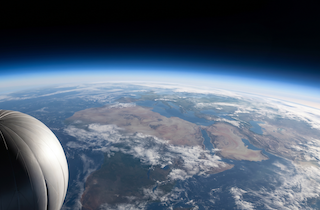
The problem I had been turning over for months, years, really, though I did not have the words for it yet, was a problem about presence. About what it means to be reliably overhead. The world has satellites, which are extraordinary and remote and expensive and episodic in their coverage. It has towers, which are terrestrial and limited and blind to terrain. It has aircraft, which are magnificent and temporary. What it does not have, not really, is something in between, something that simply stays. Something that is above you continuously, not visiting, not passing, not orbiting out of reach, but present the way a companion is present. Quietly. Reliably. Without demanding to be noticed.
What struck me most, watching the film again after Sireesh had given it its name, was that the balloon does not merely float overhead. It finds Pascal. Through fog, through narrow streets, through a city actively arranged against a child with no particular standing in it, the balloon navigates. It does not wait for Pascal to come to an open field and look up. It comes to him, in the place where he is, in the conditions that exist. That quality is what we are building toward. Not infrastructure that is available if you can reach it. Infrastructure that reaches you, above the floods, above the terrain that cables cannot cross, above the border where the last tower ends, above the city that has gone dark and needs, above all else, to be found.
And when the city tries to bring it down, because in the film it does, through the hands of boys with stones and a cruelty that is all the more striking for being so ordinary, the balloon does not fight back. It rises. That is the only answer it has, and it is the right one. There is a version of our work that tries to argue with every objection, navigate every bureaucratic constraint at ground level, force its way through friction by pressing harder into it. That version exhausts itself. The version we are building rises above the altitude where most of the friction lives. Regulatory complexity, infrastructure gaps, the absence of an ecosystem, these are real, and we engage with them seriously. But the ultimate response to being told the sky is not for you is to go higher than the argument can follow.
And there is something worth noting in how it rises, not by fighting the air, not by burning anything, not by force. It rises because it is made to belong at that altitude. That is lighter-than-air technology in one sentence: not thrust against the atmosphere, but harmony with it. The balloon does not conquer the sky. It is simply at home there.
There is something else the film understands that took me longer to see. Pascal never truly possesses the balloon. He holds no string for most of the film. The balloon accompanies him, it chooses, in whatever way a balloon in a film by Albert Lamorisse can be said to choose, to be with him. The boys who try to capture it, to own it, to hold it down, destroy it. Possession is what kills it. What we are building is not a product in the conventional sense, not something to be purchased and held and depreciated on a balance sheet. It is a presence. A communication layer that accompanies the people and the networks below it. You do not own the sky. You are accompanied by what moves through it.
Now, the colour. Lamorisse shot Paris in muted greys and browns. The streets of Ménilmontant are beautiful and cold and largely colourless on screen. The balloon does not match its environment. It was never supposed to. It is visible precisely because nothing else is quite like it, the only saturated object in a desaturated world, impossible to look past, impossible to mistake for anything else. The stratospheric infrastructure space in India is, right now, that grey Paris. No one is building here, at this altitude, at this scale, with this intention. Red Balloon does not match its environment yet. That is not a problem to be solved. That is the point. The name is not just a reference. It is a declaration about visibility, about being the one red thing in a sky that has not yet learned to expect colour.
And then there is the ending. If you have not seen the film, I will not describe it in full, it deserves to be watched, not summarised. But what I will say is this: it ends with one balloon becoming many. What began as a single red presence above a single child becomes, in the film's final extraordinary minutes, a sky full of balloons converging from across the city, rising together. One becomes a constellation. That image is not metaphor for us, it is the roadmap. We begin with one platform, one altitude band, one proof of persistent presence. And then, as we build it right, it multiplies. VISTA leads. ALTIS follows. HELIX scales. Each one another balloon rising, until the sky above is no longer empty in the way it is now, and the infrastructure that the world below depends on is finally, permanently, overhead.

What stays with me, still, is not just the engineering. It is the image of a boy looking up. Not at something passing. At something that came back.


Comments